Twenty years building and leading customer revenue functions in healthcare SaaS. Author of the Trust → Growth™ framework. Currently in selective search for VP Customer Revenue / CCO roles.
Read the frameworkI've spent 20+ years leading post-sale organizations in healthcare SaaS — building and scaling Customer Success, Professional Services, and Support under unified P&L ownership at companies from $4M to $500M+ ARR.
At Halo Health, I built the post-sale revenue engine from zero, delivering 120%+ NRR and negative churn as we scaled from $4M to $12M through acquisition. At symplr, I unified four acquired delivery organizations into one operating model, owning a $30M+ P&L and a $150M+ customer portfolio through 18 months of post-M&A integration while sustaining NRR and driving 50% delivery cost reduction.
After symplr, I took an intentional pause. Time with family, a mental reset after years of operational intensity, and space to document two decades of post-sale experience into the Trust → Growth™ framework. It's a model for how customer trust becomes the leading indicator of revenue: protect what you have, grow from within. Now preparing for the next chapter.
The accounts that renew and expand aren't the ones with the highest usage. They're the ones with the highest trust. The Trust → Growth™ framework is a customer revenue maturity model built on that thesis — trust as the leading indicator, value realization as the proof, earned growth as the consequence.
The framework organizes customer revenue across three continuous conditions: Trust (protect), Realization (value delivered), and Growth (earned expansion). Not lifecycle stages. Not a playbook. A diagnostic and execution system.
Most customer success platforms track what already happened. The Trust → Growth model tells you what's about to happen — and what to do about it.
A working prototype I built to test a hypothesis: AI transformation is a portfolio management problem wrapped around a change management problem — and the missing piece for the Chief AI Officer isn't another dashboard. It's a coach.
Cultivate gives the person holding the AI mandate a shaped pipeline (Seed → Sprout → Bloom → Harvest → Compost), a six-layer governance model with decision governance at the center — recommend vs. decide vs. execute — and an AI coach named Della who runs the weekly cadence. She pulses owners, surfaces at-risk bets, and demands an honest kill or a realized number on every initiative.
Same operator instinct as Trust → Growth™: a few fundamentals, well-run, beat any amount of tooling without them. The domain is different — Cultivate is designed for the AI transformation office inside a regulated enterprise, where safe scale is the constraint and the bar for clinical, financial, or customer-facing AI is higher than a Copilot pilot.
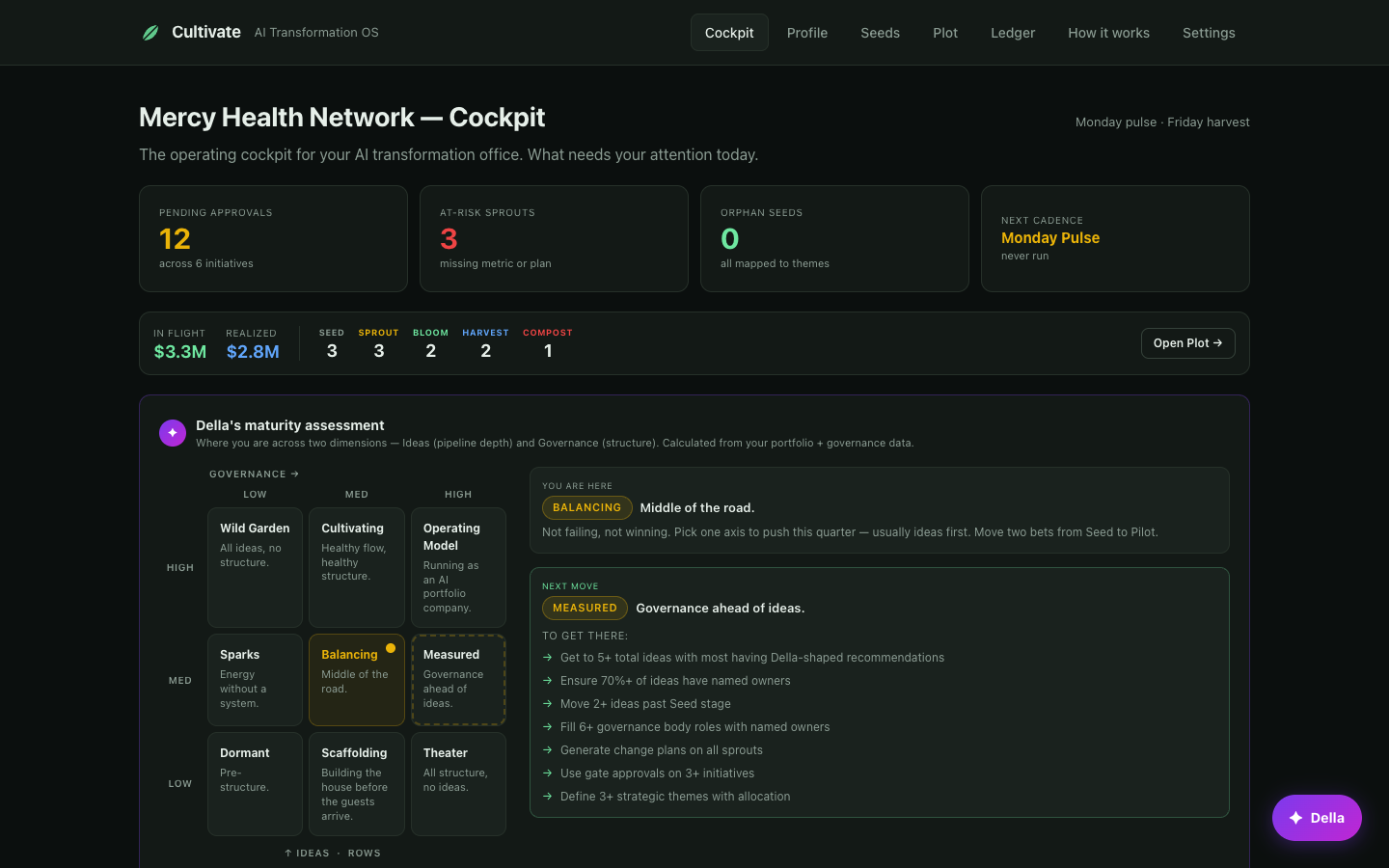
Where the AI transformation office runs from. Della's maturity diagnosis on two axes (Ideas × Governance), portfolio health, and the next move — not a generic "what should I do" prompt, but a specific recommendation grounded in the org's current state. Demo data shows a healthcare network with $3.3M in flight and $2.8M realized across the portfolio.
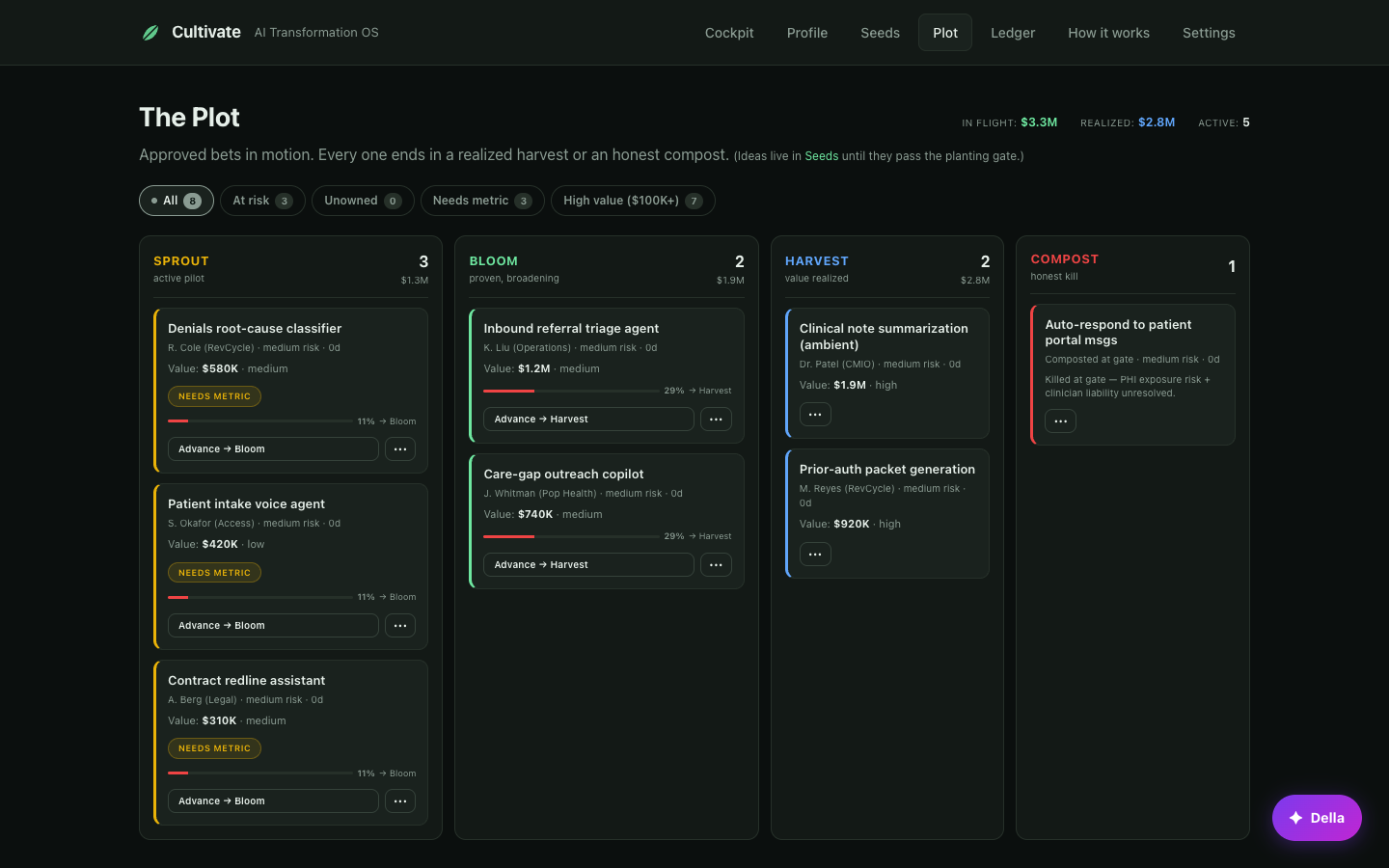
Staged kanban across Sprout → Bloom → Harvest → Compost. Each card carries owner, value theory, risk tier, and success metric. Every initiative ends in a realized number or an honest compost — no zombies in the garden. The Compost column is a feature, not a failure.
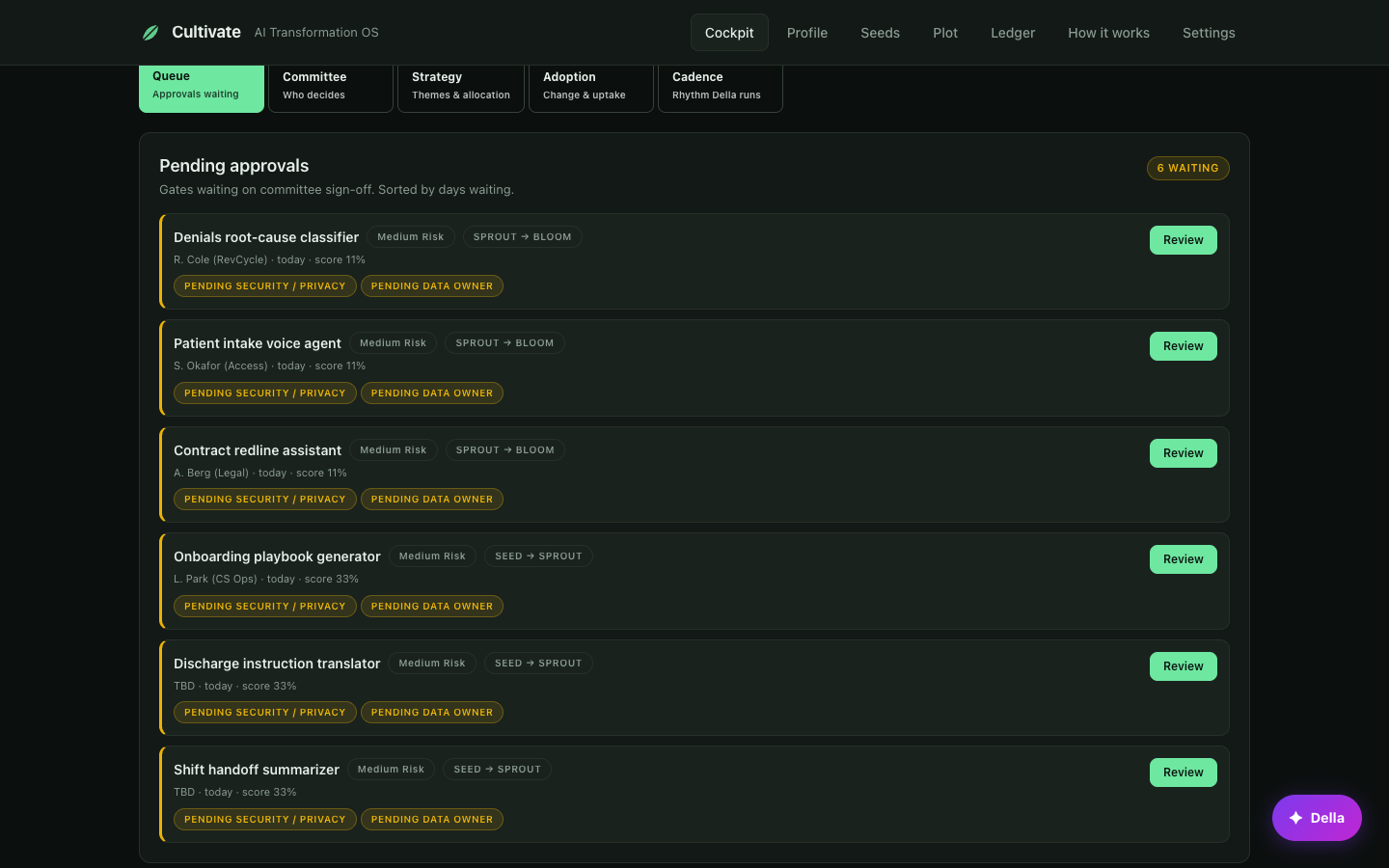
Six-layer model — use case, data, model, workflow, decision, and measurement. Pending bets route through committee sign-off with security/privacy and data-owner gates before they can advance. The piece most companies miss is decision governance: defining for every initiative whether AI can recommend, decide, or execute. Designed to unblock, not block.
Alongside Trust → Growth™ and Cultivate, I've been applying AI to adjacent problems — primarily in career management and post-sale operations. Working prototypes, not products I'm selling. They're how I've gotten fluent with modern AI development — agent orchestration, structured scoring, cross-app context — and they inform how I think about building AI-native tools for revenue and operating teams.
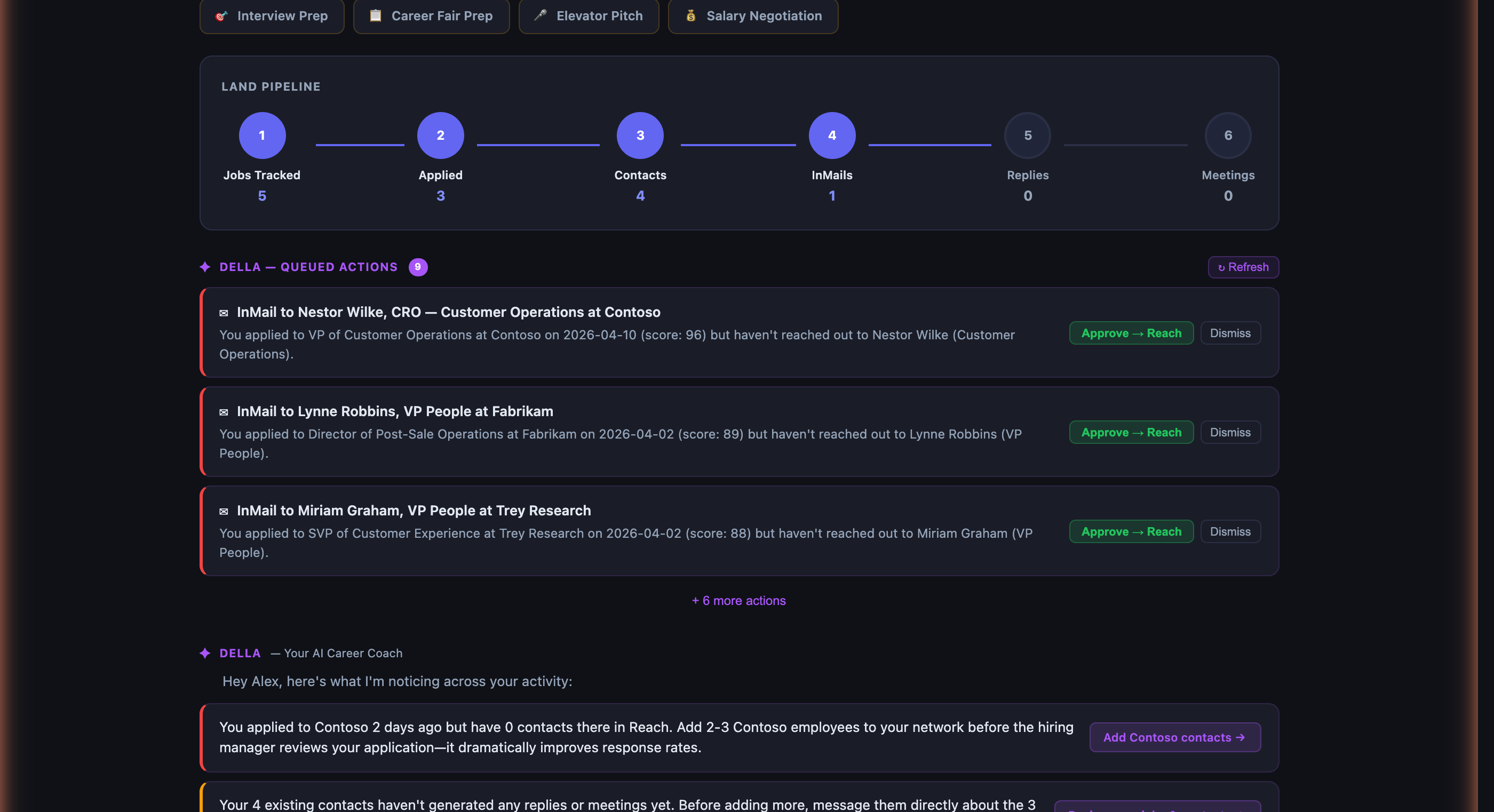
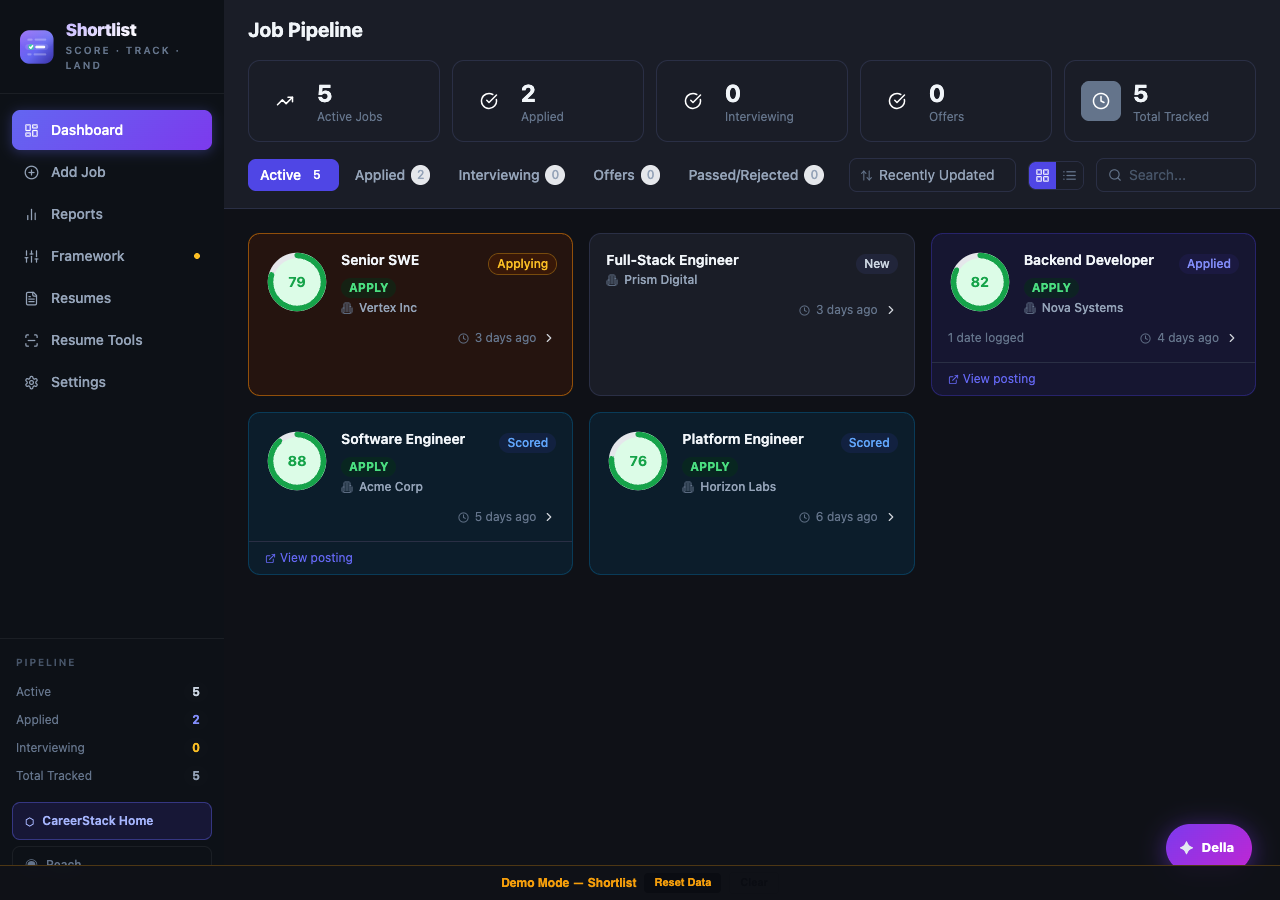
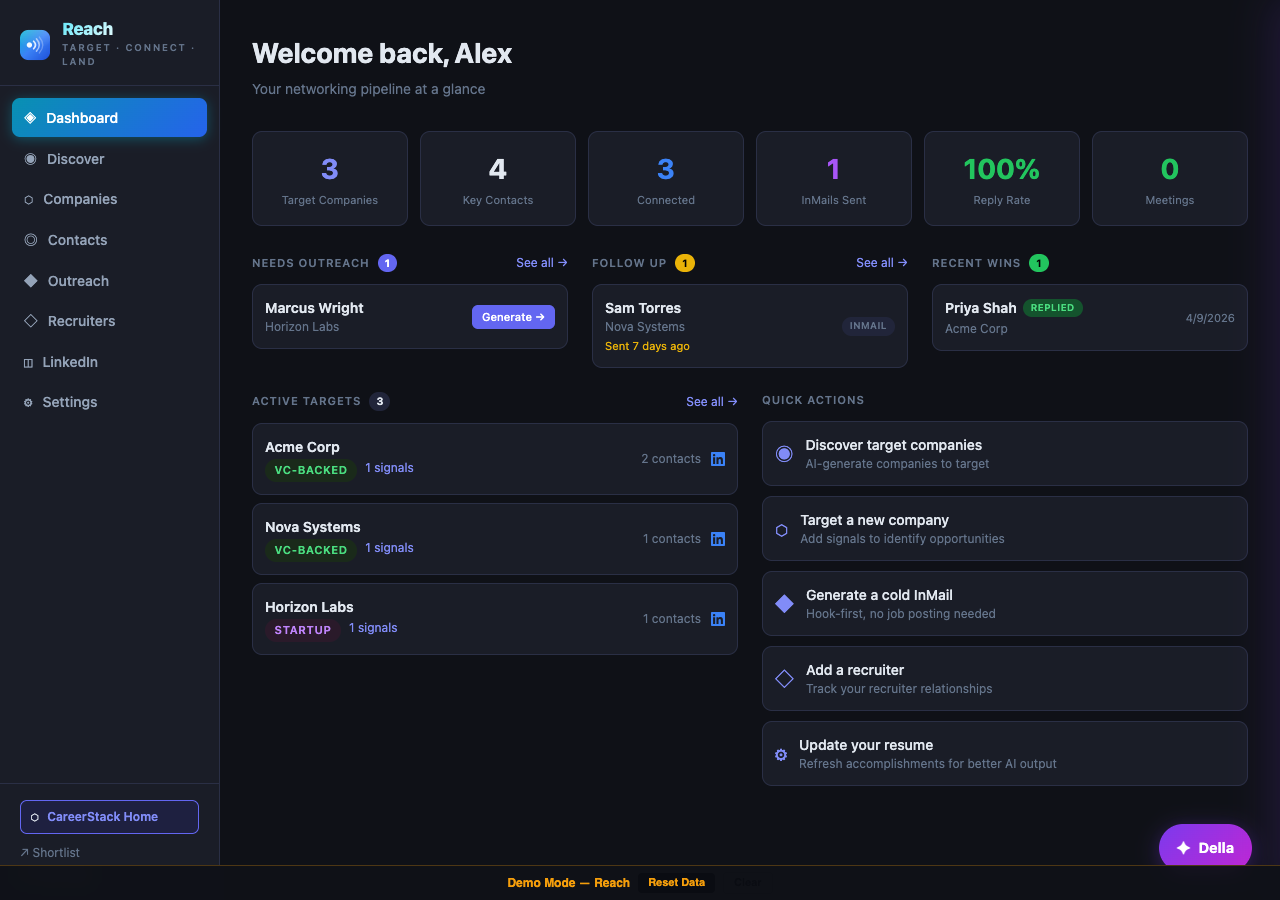
Representative work includes a career operating system (job scoring, networking intelligence, interview prep, portfolio-level pipeline visualization) with a cross-app AI layer for pattern detection and proactive recommendations — the same coach-not-dashboard pattern that shapes Cultivate. Screenshots in the next section.
Screenshots from the framework software and adjacent AI experiments. The Trust → Growth platform is the primary focus. The career-management work is how I've gotten fluent with AI development.
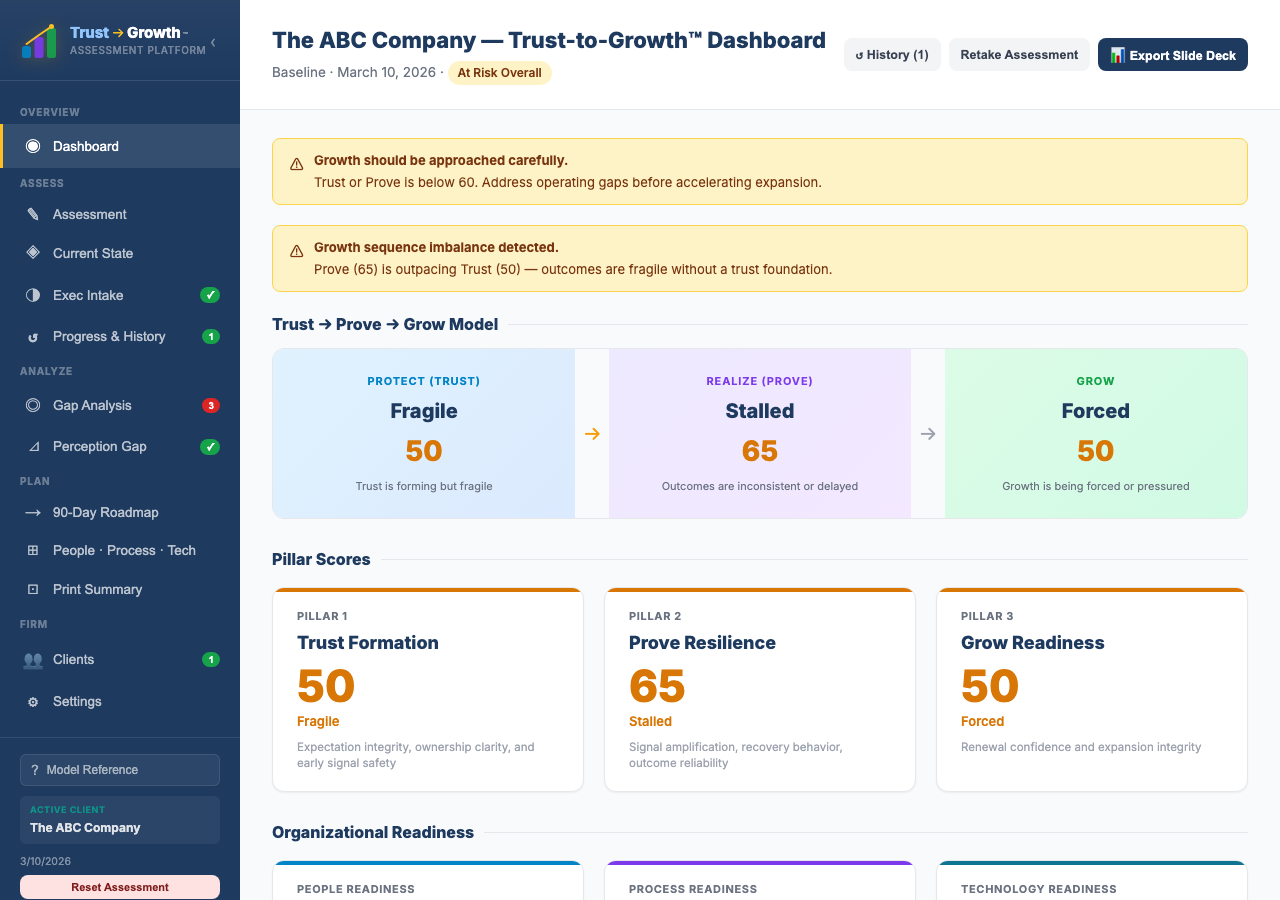
A rigorous maturity diagnosis of a company's customer revenue operating model. Scores the organization across Trust, Realization, and Growth dimensions, surfaces operating-model gaps, and produces a prioritized 90-day roadmap. Delivered as an advisory engagement.
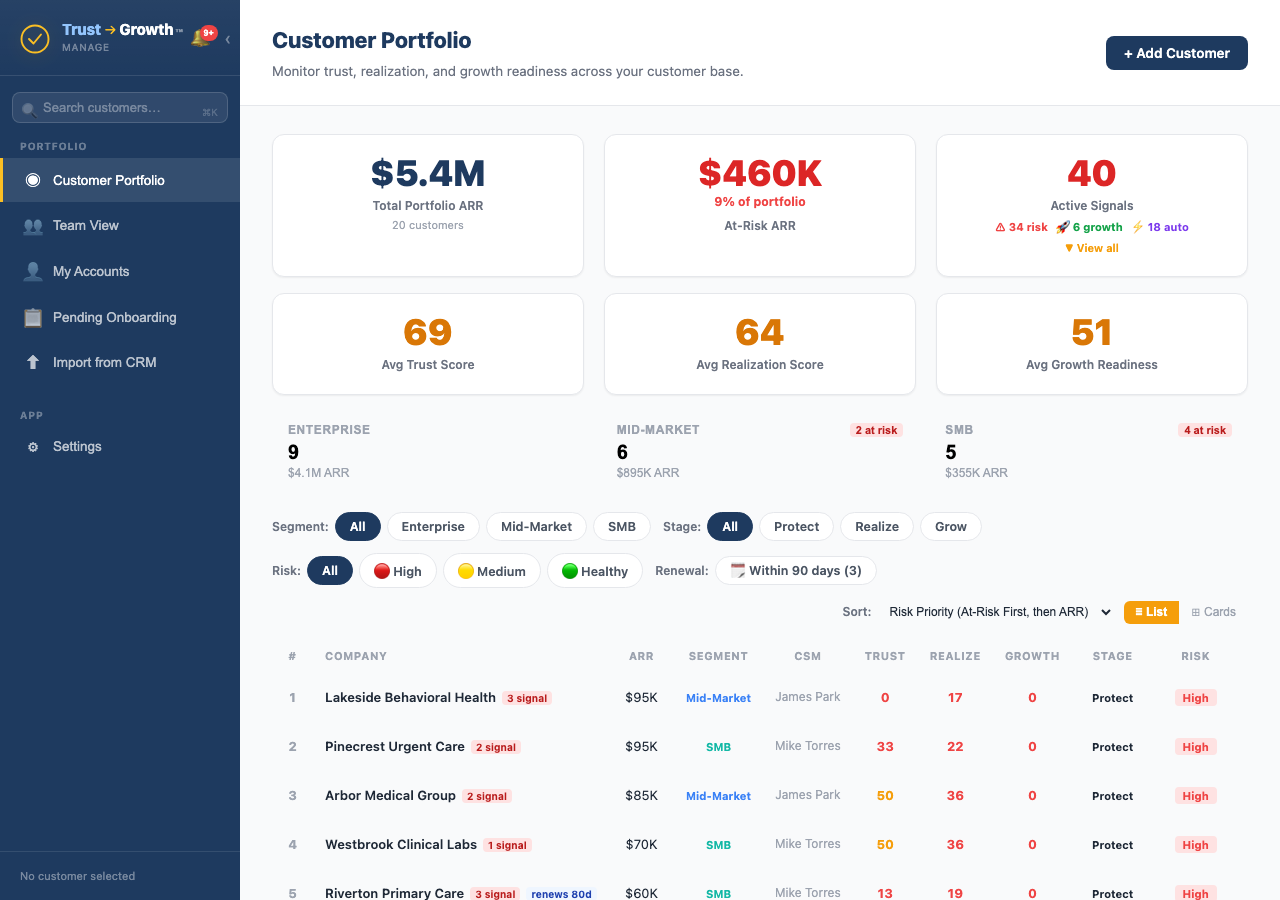
Continuous portfolio intelligence for a customer revenue org. Trust, realization, and growth signals scored across the full book of business; the system surfaces which accounts need action and suggests the intervention. AI is running the monitoring loop, not assisting the CSM after the fact.
Cross-app AI layer for career management. Runs pattern detection across job pipeline, networking activity, and reflection data — producing proactive recommendations rather than reactive chat.
AI applied to weighted scoring across multiple criteria. Demonstrates how to build opinionated evaluation frameworks rather than generic LLM wrappers.
AI-powered contact sourcing and outreach generation. Informs how signal and context can be woven into relationship-management tooling for customer revenue teams.
The Trust → Growth™ framework sits on top of a set of operating beliefs earned across 20 years of post-sale work. These are the principles that make the framework credible — and the lens I bring into every engagement, hire, or org build.
Most customer revenue orgs measure lagging signals — health scores, NPS, last-90-day usage. By the time these move, the relationship has already decided. Trust is what actually predicts what comes next, and the only metric worth building an operating system around.
Most operating problems aren't a tooling problem. They're a sequencing problem. Before you redesign a function, instrument a playbook, or roll out an AI agent, you need an honest picture of where the operating model breaks down. Diagnosis first, intervention second.
Heroic CSMs save individual accounts. Systems save books of business. Everything I've built — at Halo Health, at symplr, and in the Trust → Growth framework — has been about turning repeatable operator judgment into infrastructure that scales past any single person.
In selective search for VP Customer Revenue, VP Post-Sale, Chief Customer Officer, or AI-transformation leadership roles where operator experience, the Trust → Growth™ framework, and AI-native tooling can compound into real retention, expansion, or safe-scale outcomes. Healthcare and regulated-enterprise contexts are a natural fit. Based in Cincinnati; open to remote, hybrid, or relocation for the right role.
Also open to a conversation if you're scaling a post-sale organization, navigating post-acquisition integration, or thinking through how AI agents change the customer revenue or transformation operating model.